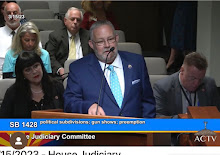
The ongoing debate over gun control in the United States has taken a new turn with a proposed law in New York State that aims to regulate 3D printers capable of producing firearms. Thank you to John Crump[1] over at Ammoland[2] for bringing light to this proposed legislation. The legislation mandates fingerprinting, criminal background checks, and imposes a waiting period for anyone looking to purchase a 3D printer. While the intention is ostensibly to prevent the production of unregulated firearms, the proposal raises significant constitutional, practical, and ethical concerns.[3] I want to critically analyze the proposed New York law, exposing its flaws, constitutional vulnerabilities, and broader implications for innovation and civil liberties.

Constitutional Concerns
First Amendment Implications
The proposal's most glaring shortcoming lies in its
encroachment on First Amendment rights, specifically the right to free
expression. 3D printers serve as a medium for creativity and innovation, not
merely as machinery for the manufacture of firearms. As such, any law that
restricts access to 3D printers effectively curtails the free exchange of ideas
and stifles creative expression. The U.S. Supreme Court has long held that
freedom of expression is protected unless it incites imminent lawless action or
creates a true threat.[4]
The proposed law, by generalizing all 3D printer purchases as potential
threats, neglects this constitutional principle.
Second Amendment Implications
The proposed law also raises concerns related to the Second
Amendment. While the primary focus is on 3D printers, the underlying issue
pertains to firearms. If a 3D printer can be used to produce a firearm, then
the proposed regulation indirectly places a burden on an individual's right to
bear arms. The U.S. Supreme Court clarified that the Second Amendment protects
an individual's right to possess a firearm unconnected with service in a
militia.[5]
As such, any law infringing on this right requires strict scrutiny and must
demonstrate a compelling governmental interest. Even if such an interest could
be argued, the proposed law is unlikely to pass the "least restrictive
means" test.[6]
Fourth Amendment Implications
The mandated fingerprinting and criminal background checks
may also violate the Fourth Amendment's protections against unreasonable
searches and seizures. The U.S. Supreme Court has consistently held that
individuals have a reasonable expectation of privacy and are entitled to be
free from unwarranted governmental intrusion.[7]
While there are exceptions for public safety, these must be narrowly tailored
and proportionate to the interest protected. The proposed New York law, by
imposing a blanket restriction on all 3D printer purchases, appears to
overreach.
Practical Concerns
The proposal’s practicality is equally questionable. The majority
of 3D printer users employ the technology for non-firearm-related purposes,
such as prototyping and household use.[8]
Subjecting all these users to rigorous background checks and waiting periods is
an inefficient allocation of resources. Additionally, the law may yield
unintended consequences, such as stifling innovation and driving the 3D
printing industry—and its economic benefits—out of the state. Finally, the
proposal displays a lack of technological understanding, as 3D printing
capabilities are continuously evolving. Today’s 3D printers have myriad
applications, many of which may be unknown at the time of purchase, rendering
the regulation both overbroad and underinclusive.
The proposed New York law targeting 3D printers is an
overreach that fails to balance public safety concerns with constitutional
rights. It disregards First and Second Amendment protections, poses Fourth
Amendment challenges, and demonstrates impracticality. While the regulation of
technology, especially as it intersects with issues like firearm production, is
a complex task, this proposed law is not the solution. Policymakers should
strive for more nuanced, constitutionally sound approaches that do not
compromise civil liberties or stifle innovation.
[3] Ammoland.com. (2023). NY Lawmakers
Want Background Checks & Waiting Periods for 3D Printers. Retrieved from https://www.ammoland.com/2023/10/ny-lawmakers-want-background-checks-waiting-periods-for-3d-printers
[4] Brandenburg v. Ohio, 395 U.S. 444
(1969). Retrieved from https://supreme.justia.com/cases/federal/us/395/444/.
[5] District of Columbia v. Heller, 554
U.S. 570 (2008). Retrieved from https://supreme.justia.com/cases/federal/us/554/570/.
[6] United States v. Playboy
Entertainment Group, Inc., 529 U.S. 803 (2000). Retrieved from https://supreme.justia.com/cases/federal/us/529/803/.
[7] Katz v. United States, 389 U.S. 347
(1967). Retrieved from https://supreme.justia.com/cases/federal/us/389/347/.
[8] Ammoland.com. (2023). NY Lawmakers
Want Background Checks & Waiting Periods for 3D Printers. Retrieved from https://www.ammoland.com/2023/10/ny-lawmakers-want-background-checks-waiting-periods-for-3d-printers