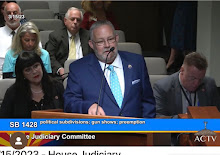
California has long been at the forefront of gun control legislation, often introducing laws aimed at reducing firearm violence and tightening restrictions on who can legally own a firearm. Governor Gavin Newsom’s latest move follows this trend, expanding the criteria under which an individual can be denied a firearm to include those accused of stalking. On the surface, this may seem like a well-intentioned policy aimed at preventing dangerous individuals from accessing firearms. However, a closer examination reveals significant concerns regarding the violation of due process rights and the presumption of innocence that are fundamental to our legal system.
The Problem with “Accused”
The most alarming aspect of this legislation is the
inclusion of individuals who are merely accused of stalking. In the
United States, individuals are presumed innocent until proven guilty. This
principle is enshrined in the Fifth and Fourteenth Amendments, which guarantee
due process of law before any deprivation of life, liberty, or property. By preventing
someone who has not been convicted of a crime from exercising their Second
Amendment rights, California’s law fundamentally undermines this constitutional
guarantee.
Stalking accusations, like many other allegations, can be
complex and nuanced. The legal process exists to determine whether the accused
is, in fact, guilty. By allowing mere accusations to result in the deprivation
of a constitutional right, the law strips the accused of their ability to
defend themselves in court before facing penalties. This circumvents the
necessary legal procedures designed to protect individuals from arbitrary
government action.
The Second Amendment and Individual Rights
The Second Amendment of the U.S. Constitution clearly
establishes the right of individuals to bear arms. Over the years, this right
has been subject to various interpretations and limitations, but it remains a
cornerstone of American individual liberty. When the government starts
restricting this right based on accusations rather than convictions, it sets a
dangerous precedent. If the government can infringe upon Second Amendment
rights based solely on accusations, what’s to stop similar restrictions from being
applied to other fundamental rights, like free speech or voting?
One of the core principles of constitutional rights is that
they cannot be taken away lightly. The legal system has long established that
fundamental rights can only be restricted under strict scrutiny, the highest
standard of judicial review. To pass strict scrutiny, the government must
demonstrate that a law is narrowly tailored to serve a compelling state
interest. While public safety is undeniably a compelling interest, restricting
gun ownership based on accusations fails to meet the “narrowly tailored”
requirement. There are less restrictive ways to ensure public safety, such as
ensuring due process through the courts, rather than bypassing it entirely.
Precedents and the Slippery Slope
This is not the first time California has taken an
aggressive stance on gun control, and it likely won’t be the last. However, by
expanding the criteria for denying gun ownership to individuals accused of
stalking, the state risks creating a slippery slope. If the threshold for
restricting Second Amendment rights becomes merely an accusation, what other
rights might follow suit?
It is also worth noting that accusations can sometimes be
false, exaggerated, or made in the heat of emotional disputes. Domestic
situations, workplace conflicts, or personal vendettas can lead to wrongful
accusations, with potentially devastating consequences. Without the safeguard
of due process, individuals could be stripped of their rights based on flimsy
or false claims, with no immediate recourse.
California’s new law could also disproportionately impact
vulnerable populations. Historically, laws that rely on accusations without
proper judicial oversight tend to affect minority communities more harshly, as
they are often subject to higher rates of accusations and arrests. This law
could exacerbate existing inequalities in the criminal justice system by
depriving individuals in these communities of their constitutional rights
without proper legal proceedings.
Due Process: More Than Just a Concept
At its core, due process is more than just a legal
concept—it is a safeguard that protects citizens from government overreach. It
ensures that every person has the right to be heard, to present evidence, and
to have their case decided by a neutral party. California’s new legislation
bypasses these protections. By shifting the burden from the state to prove
guilt to the accused to prove innocence, it turns the presumption of innocence
on its head.
Imagine being accused of a crime—stalking, in this case—but
before you’ve had your day in court, the government has already restricted your
constitutional rights. This is what this legislation essentially allows.
Without the opportunity for the accused to defend themselves or present their
side of the story, they are effectively punished before any determination of
guilt has been made.
In a country that prides itself on justice and fairness,
this is an alarming precedent. While public safety is an imperative, it cannot
come at the expense of constitutional rights. Protecting due process is
essential, not just for those accused of stalking, but for everyone. Once we
begin allowing accusations to substitute for convictions in the realm of
constitutional rights, we open the door to significant abuses of power.
A Dangerous Path Forward
Governor Newsom’s expansion of California’s gun control laws
may be rooted in good intentions, but its impact on due process and the
presumption of innocence is extremely concerning. Denying individuals their Constitutional
rights based on accusations alone violates the foundational principles of
fairness and justice that are supposed to protect every citizen.
If this law is allowed to stand, it sets a precedent that
could easily expand to other rights and other accusations. As Americans, we
must be vigilant in protecting not only public safety but also the
constitutional rights that define our nation. This balance is difficult, but it
cannot be achieved by sacrificing due process and treating accusations as
convictions.
At the heart of the American legal system is the principle
that every individual is innocent until proven guilty. Any legislation that
undermines this principle—whether in the name of gun control or any other
policy—should be critically examined and challenged. Rights, once taken away,
are difficult to regain, and it is imperative that we protect them vigilantly.
California’s latest gun control measure should serve as a
wake-up call to those who value individual liberty and constitutional
protections. In the pursuit of safety, we must not lose sight of the
fundamental principles that make our justice system fair and just. Every
accused individual deserves their day in court, and no one should lose their
rights without due process.